Kidney Stone Diagnosis: Which Tests May Your Doctor Recommend?
Introduction
Kidney stones can cause sudden pain in the side or back, nausea, vomiting, urinary discomfort, or blood in the urine. However, symptoms alone may not reveal the size, location, or type of stone. Proper diagnosis helps doctors understand whether the stone is likely to pass naturally or whether further treatment may be required.
Patients searching for the best kidney stone doctor in Faridabad may be advised to undergo a combination of urine tests, blood tests, ultrasound, or other imaging depending on their symptoms and medical history.
Why Testing Is Important for Kidney Stones
Kidney stones can vary greatly in size and location. A small stone may pass through the urinary tract with medical guidance, while a larger stone may cause blockage, swelling, infection, or persistent pain.
A best kidney doctor in Faridabad may recommend diagnostic tests to answer important questions such as:
- Is a kidney stone actually present?
- Where is the stone located?
- How large is it?
- Is urine flow being blocked?
- Is there an associated infection?
- Are the kidneys functioning normally?
The answers help the doctor decide the most appropriate next step.
1. Urine Tests
Urine analysis is commonly used when kidney stones are suspected. The test may help detect blood, signs of infection, crystals, or other abnormalities.
If symptoms such as burning urination, fever, or frequent urination are present, urine testing can also help determine whether an infection may be contributing to the problem.
Patients consulting the best kidney doctor in Faridabad may sometimes be asked to undergo additional urine testing, particularly if stones keep returning.
2. Blood Tests
Blood tests may be recommended to evaluate kidney function and measure certain substances that can contribute to stone formation.
Tests may include markers of kidney function along with calcium, uric acid, or other parameters depending on the patient’s condition.
A best kidney doctor in Faridabad will usually interpret blood results together with symptoms, urine findings, and imaging rather than relying on one test alone.
3. Ultrasound for Kidney Stones
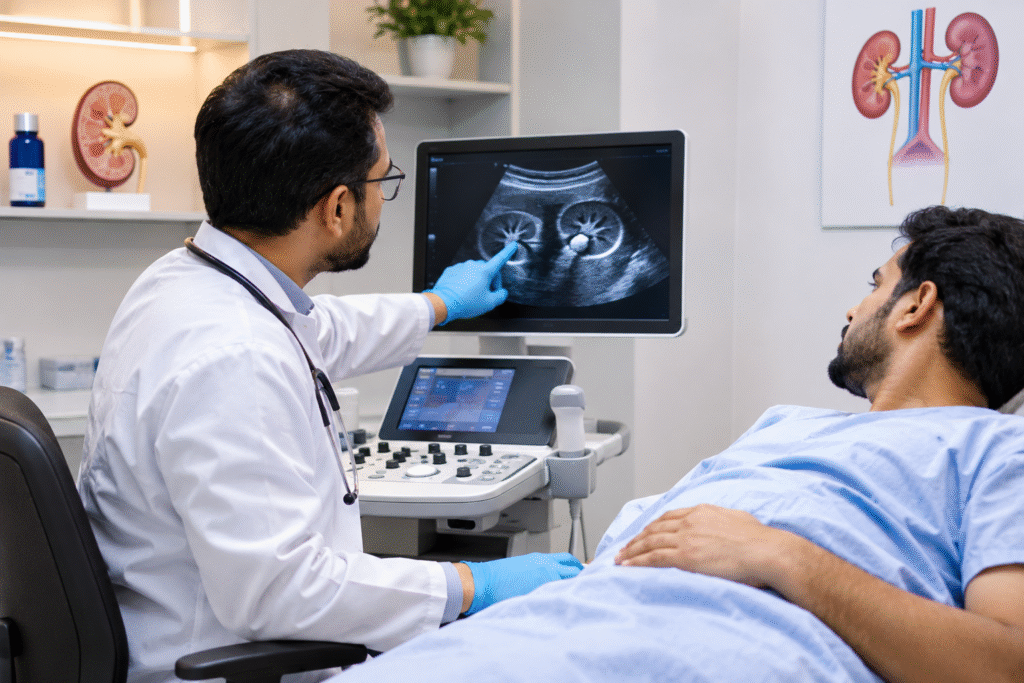
Ultrasound is a commonly used imaging method for evaluating the kidneys and urinary system. It uses sound waves to create images and does not involve ionizing radiation.
Ultrasound may help identify certain kidney stones, swelling of the kidney, or signs that urine flow is obstructed. It can also provide information about the kidneys and bladder.
A best hospital in Faridabad with hospital-based diagnostic services may allow patients to complete consultation, ultrasound, and report review within one healthcare setting.
However, very small stones or stones in certain locations may not always be clearly visible on ultrasound, so the doctor may recommend another imaging test if needed.
4. CT Scan When More Detail Is Needed
A CT scan can provide detailed images of the urinary tract and may help doctors identify the size and exact location of stones.
It may be considered when symptoms are severe, the diagnosis remains uncertain, or the doctor needs more detailed information before deciding on treatment.
A best kidney doctor in Faridabad will decide whether a CT scan is appropriate based on the clinical situation. Not every patient with suspected kidney stones requires the same imaging test.
5. Analysis of a Passed Kidney Stone
If a patient passes a stone naturally, the doctor may sometimes recommend collecting it for laboratory analysis.
Understanding the stone’s composition can be useful when stones recur. Different stones may be associated with different dietary, metabolic, or medical factors.
The best kidney doctor in Faridabad may use this information along with blood and urine results to suggest practical prevention strategies.
When Are Additional Tests Needed?
Patients who develop kidney stones repeatedly may need further evaluation to understand why stones continue to form. This may involve additional blood tests, urine collection over a longer period, dietary assessment, or evaluation for underlying medical conditions.
Patients with diabetes, high blood pressure, recurrent urinary infections, or reduced kidney function may also need closer monitoring.
Access to a best multispecialty hospital in Faridabad can be useful when kidney concerns need support from different medical specialties or additional diagnostic services.
What Happens After the Diagnosis?
Treatment depends on the size, location, symptoms, and impact of the kidney stone.
Some smaller stones may pass naturally with appropriate hydration, medicines, and medical supervision. Other stones may require additional procedures, especially if they are large, causing blockage, associated with infection, or producing persistent symptoms.
A best kidney doctor in Faridabad can explain the available options based on the test results and the patient’s overall health.
When Should You Seek Urgent Medical Care?
Kidney stone pain can sometimes become an emergency. Patients should seek prompt medical attention if they experience:
- Severe or worsening pain
- Fever or chills with urinary symptoms
- Persistent vomiting
- Difficulty or inability to pass urine
- Significant blood in the urine
- Extreme weakness or fainting
A best hospital in Faridabad search may help identify nearby healthcare facilities, but in a medical emergency the priority should be reaching an appropriate emergency facility without unnecessary delay.
Choosing Hospital-Based Kidney Care
Kidney stone evaluation may involve consultation, laboratory testing, ultrasound, imaging, medication, and follow-up care.
A best multispecialty hospital in Faridabad may offer the convenience of coordinating these services within one medical setting. Patients should still choose a facility based on their specific healthcare needs, diagnostic support, doctor availability, communication, and continuity of care rather than rankings alone.
Arsh Hospital provides hospital-based consultation and diagnostic support for patients with kidney stones and other kidney or urinary concerns.
Conclusion
Kidney stone diagnosis usually involves more than simply identifying pain. Urine tests, blood investigations, ultrasound, CT imaging, and stone analysis may all play a role depending on the individual case.
Consulting the best kidney doctor in Faridabad can help patients understand which tests are appropriate and what the results mean for treatment. Whether you are comparing the best hospital in Faridabad or a best multispecialty hospital in Faridabad, focus on access to suitable diagnostics, specialist guidance, and proper follow-up care.
Early and accurate evaluation can help determine the right treatment approach and may also provide useful information for reducing the risk of future kidney stones.
Frequently Asked Questions
A doctor may begin with urine and blood tests along with imaging such as ultrasound, depending on symptoms and medical history.
Ultrasound can identify many kidney stones and may show kidney swelling or urinary obstruction, but some small stones may require other imaging for clearer evaluation.
Blood tests may help assess kidney function and measure substances such as calcium or uric acid that can sometimes be related to stone formation.
No. A CT scan may be recommended when more detailed imaging is needed. The appropriate test depends on symptoms and the doctor’s assessment.